

When you buy something using links in our stories, we may earn a small commission. Read more about our policy.
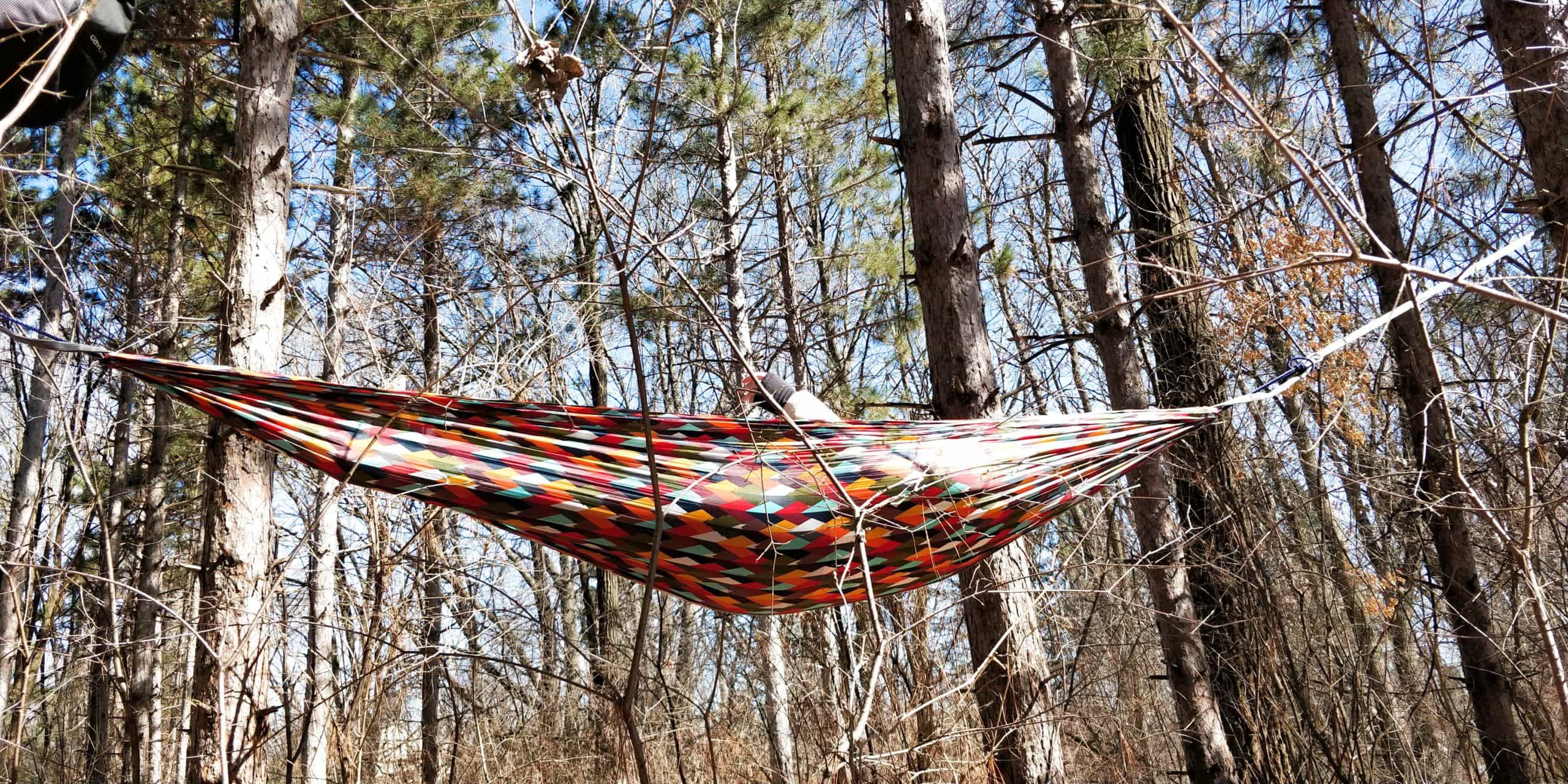
Tree straps are the most important accessory in your hammock setup. They’re what connect your hammock to the trees, and the right pair makes the difference between a secure, tree-friendly hang and a frustrating (or bark-damaging) mess.
Most hammocks don’t come with straps. They’ll include carabiners, but you’ll need to buy the suspension system separately. A few brands (like Wise Owl Outfitters) do include straps, which is a nice bonus if you’re buying your first hammock.
Before we get into the best straps, there’s one major disclaimer: do not hang a hammock with rope. Thin rope digs into bark and damages trees. Many state and national parks now require straps that are at least 1″ wide. Some require 1.5″ or wider. Please do yourself and the trees a favor and get proper tree straps.
Below, I cover the best hammock straps from all the top brands, plus how to actually hang your hammock and what to look for when shopping.
Best hammock straps at a glance
- Best Budget (includes carabiners): Wise Owl Outfitters Talon Hammock Straps (~$17-$22) — 10 ft, 500 lbs, 38 loops, carabiners included
- Most Colorful Options: Grand Trunk Trunk Straps (~$30) — 10 ft, 400 lbs, 36 loops, lifetime warranty (you will likely get a better price on Amazon, but also check out the Grand Trunk website for more colors)
- Best All-Around (fan favorite): ENO Atlas Hammock Straps (~$30) — 9 ft, 400 lbs, 30 loops, tapered design
- Best for Backyard/Weather-Proof: ENO Apollo Hammock Straps (~$40) — 10 ft, 400 lbs, infinite adjustment, stainless steel hardware
- Best Ultralight: ENO Helios Ultralight Suspension System (~$35) — 8 ft, 300 lbs, 4.3 oz
- Best Overall (camping): Kammok Python 10 (~$30) — 10 ft, 500 lbs, 40 loops, 8.2 oz
- Best Extra-Long: Kammok Python 15 (~$39) — 15 ft, 500 lbs, 66 loops, 11.8 oz
What to look for in hammock tree straps
Length. Longer straps give you more options. Standard straps are 9 to 10 ft per side, which works for most situations. If you camp in areas with widely spaced trees or thick trunks, consider 13 to 15 ft straps or get a pair of extenders.
Width. Wider straps distribute weight better and cause less tree damage. Look for at least 1″ wide where the strap wraps around the tree. The best straps (ENO Atlas, Kammok Python) taper from 1.5″ at the tree to .75″ on the daisy chain to save weight while still protecting bark.
Weight. If you’re backpacking, every ounce counts. Standard daisy chain straps run 8 to 13 oz. Ultralight options (ENO Helios at 4.3 oz, Kammok Python 10 UL at 3 oz) cut weight significantly but have lower weight capacity.
Loops/Adjustment Points. More loops means more fine-tuning. Most good straps have 15 to 20 loops per side. The Kammok Python 15 has 33 per side. Some systems (ENO Apollo, ENO Helios) use infinite adjustment instead of fixed loops.
Weight Capacity. Standard straps hold 400 to 500 lbs combined. Ultralight models drop to 300 lbs. Be sure to match the capacity to your hammock and how many people will use it.
Tree Friendliness. This really matters. Wider, flat webbing protects bark. Variable-width designs that widen at the tree end are the best of both worlds. Avoid anything narrower than .75″ where it contacts the tree.
The best hammock tree straps
Wise Owl Outfitters Talon Hammock Straps
The best value on this list. Wise Owl includes two carabiners in the box, which is something most strap brands skip. For under $25, you get a complete hanging kit: two 10 ft straps, two carabiners, and a carry pouch.
Each strap has 19 loops (38 total), which gives you plenty of adjustability. The 1″ webbing is tree-friendly and won’t stretch. At 500 lbs combined capacity, they’ll handle any double hammock.
They’re not the lightest at around 15 oz, and the carabiners are functional but basic (not rated for climbing, obviously). If you already own a hammock without straps, or you’re buying your first setup and want everything in one package, these are the move.
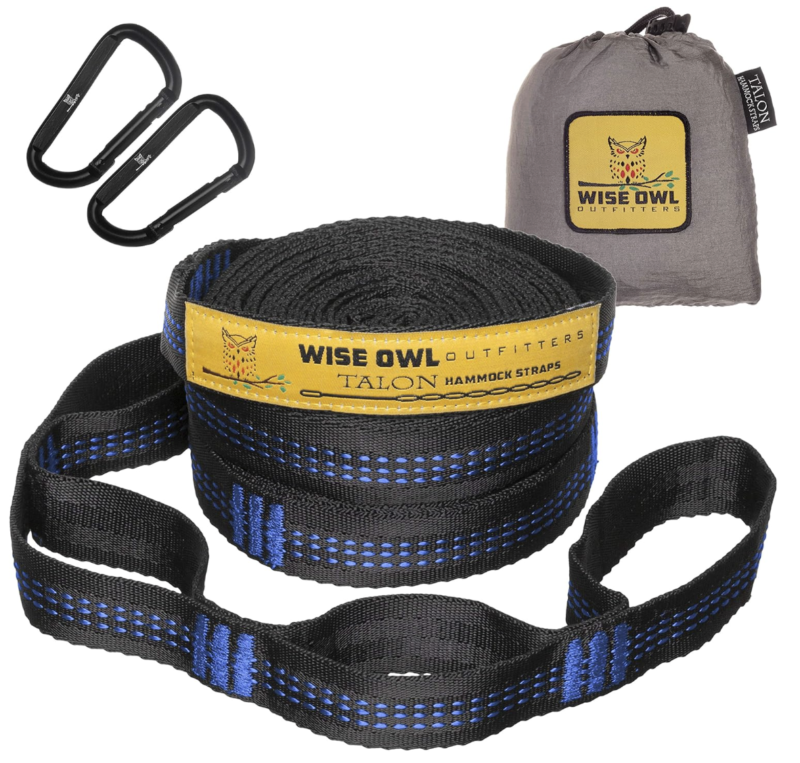
- Length: 10 ft per strap (20 ft combined)
- Loops: 19 per strap (38 combined)
- Weight capacity: 500 lbs combined
- Weight: ~15 oz
- Width: 1″
- Includes: 2 straps, 2 carabiners, carry pouch
- Best for: Budget buyers, first-time hammock owners, complete kit
Grand Trunk Trunk Straps
Grand Trunk’s straps are functionally solid, but what sets them apart is the color selection. They come in bold, bright colors that match Grand Trunk’s hammock patterns. If you care about aesthetics (or just want straps you can actually see at night), these are the ones.
Each strap is 10 ft with 18 loops per side (36 total), so adjustability is good. The 1″ webbing holds up to 400 lbs combined. They weigh 12 oz, which is mid-range.
Grand Trunk backs these with a lifetime warranty. If a strap ever breaks, they’ll replace it.
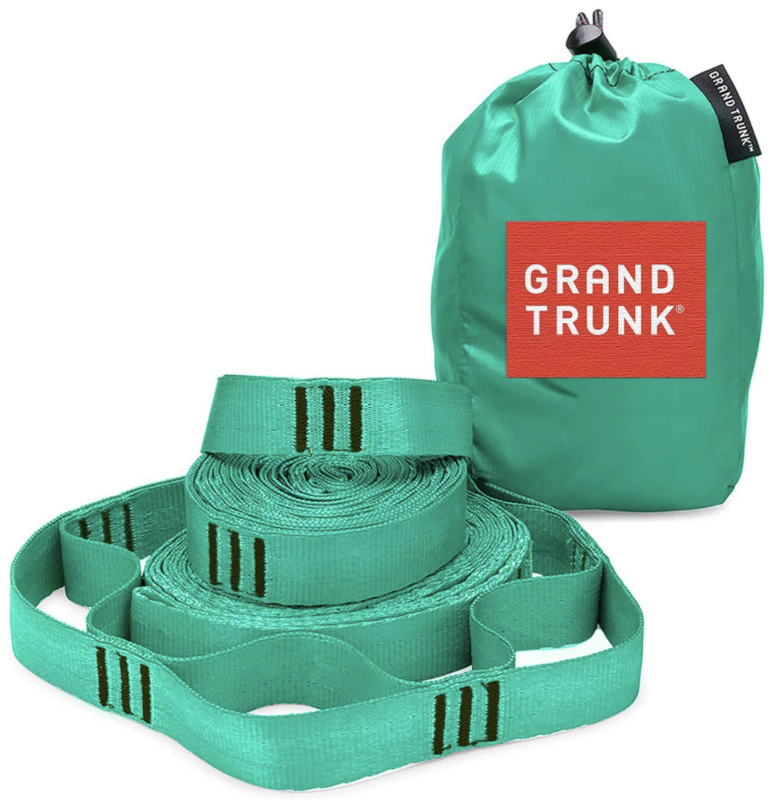
- Length: 10 ft per strap (20 ft combined)
- Loops: 18 per strap (36 combined)
- Weight capacity: 400 lbs combined
- Weight: 12 oz
- Width: 1″
- Includes: 2 straps, carry sack
- Best for: Color matching, casual hammocking, backyard/park use
ENO Atlas Hammock Straps
ENO invented the knotless hammock suspension system, and the Atlas is the current version of the strap that started it all. It’s the most popular hammock strap on the market for good reason.
The Atlas uses a tapered design: 1.5″ wide where it wraps around the tree (for bark protection), tapering down to .75″ on the daisy chain (for weight savings). At 9 oz, they’re lighter than most standard straps. Each strap is 9 ft with 15 loops per side (30 combined), and reflective accent stitching makes them easier to spot at night.
They’re compatible with all ENO hammocks (toggle system hammocks require carabiners sold separately) and work with most other brands too.
Need more length? The ENO Atlas XL Hammock Straps (~$40) extend to 13’6″ per strap with 20 loops per side and weigh 13 oz. Same tapered design, same 400 lb capacity. Great for thick trunks or widely spaced trees.
Need even more length? The ENO Atlas EXT Strap Extenders add length to any Atlas strap setup for those situations where you’re just a few feet short.
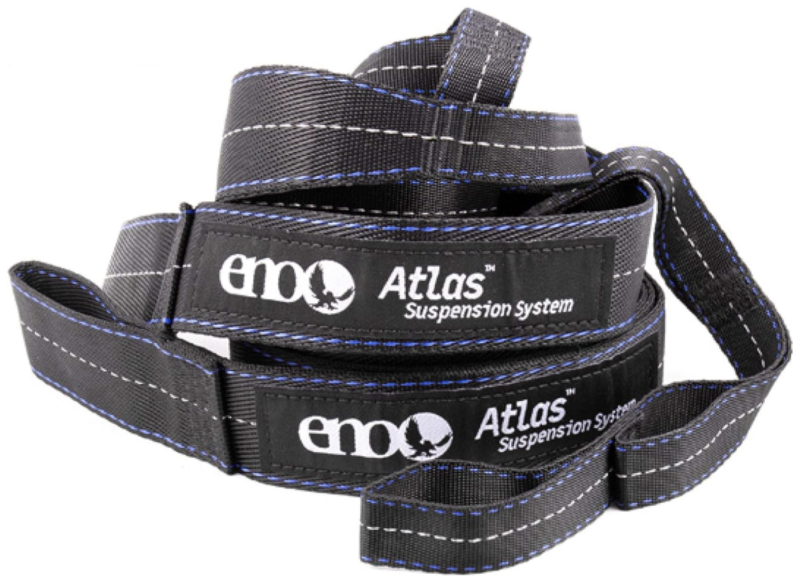
- Length: 9 ft per strap (18 ft combined)
- Loops: 15 per strap (30 combined)
- Weight capacity: 400 lbs combined
- Weight: 9 oz
- Width: 1.5″ tapering to .75″
- Includes: 2 straps, stuff sack
- Best for: Everyday hammocking, car camping, most users, the standard
ENO Apollo Hammock Straps
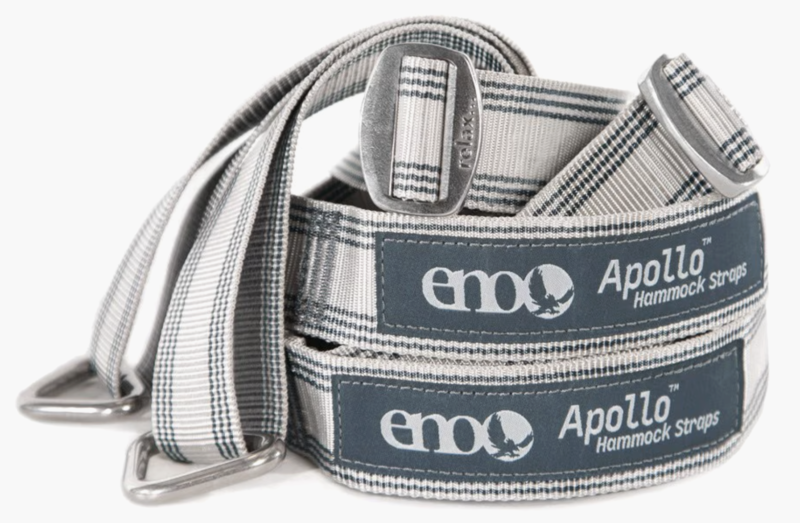
The Apollo is ENO’s heavy-duty, weather-resistant option designed for semi-permanent or backyard setups. If you leave your hammock straps on the trees for weeks at a time (around an ENO SuperNest, for example), these are built for that.
The key difference from the Atlas: the Apollo uses an infinite adjustment system instead of fixed daisy chain loops. You slide the strap to any position you want, which means you can dial in your hang with more precision. The stainless steel hardware is built for long-term outdoor exposure.
At 19 oz they’re heavier than the Atlas, so these aren’t the straps you’d bring backpacking. But for a patio, backyard, or semi-permanent campsite setup, the build quality and weather resistance are worth it. The 1.5″ wide webbing is generous on trees.
- Length: 10 ft per strap (20 ft combined)
- Adjustment: Infinite (no fixed loops)
- Weight capacity: 400 lbs combined
- Weight: 19 oz
- Width: 1.5″
- Material: 1000D polyfilament webbing, stainless steel hardware
- Includes: 2 straps
- Best for: Backyard, SuperNest pairing, semi-permanent setups, weather exposure
ENO Helios Ultralight Suspension System
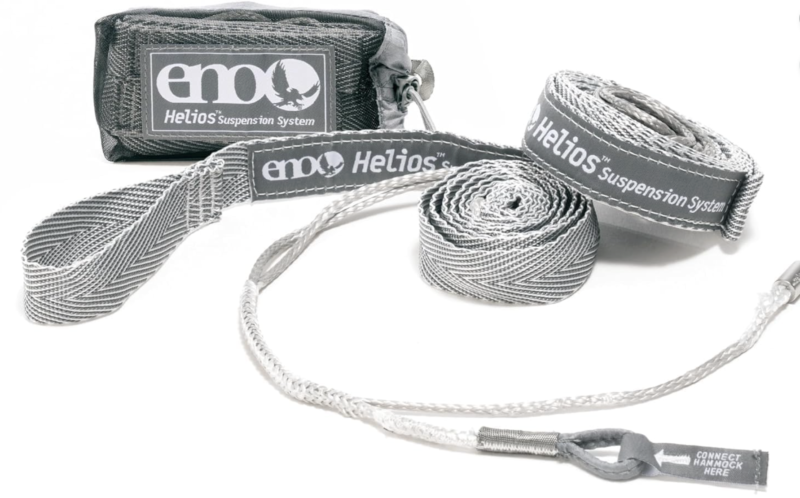
If you’re counting ounces, the Helios is ENO’s answer. At just 4.3 oz for the pair, it’s built for backpacking and ultralight setups. The system uses a combination of 1″ polyfilament webbing (for the tree wrap) and Silverlite cord with ENO’s Microtune adjustment system (for the suspension line).
The Microtune system lets you dial in your hang without fixed loops. It’s a different feel than a daisy chain. Takes a minute to learn, but once you’ve got it, setup is fast.
The tradeoff: 300 lb capacity (vs. 400+ on standard straps) and shorter 8 ft length per strap. For solo backpackers, that’s fine. For sharing a double hammock, you’ll want something beefier.
The Helios pairs naturally with ENO’s Sub-series and other toggle-system hammocks. No carabiners needed for toggle hammocks.
Need more length? The ENO Helios XL Ultralight Suspension System (~$45) stretches to 13’5″ per strap and weighs 6.3 oz. Same 300 lb capacity, same Microtune adjustment. Worth the extra $10 and 2 oz if you camp in areas with larger or more widely spaced trees.
- Length: 8’1″ per strap (16’2″ combined)
- Adjustment: Microtune (infinite)
- Weight capacity: 300 lbs combined
- Weight: 4.3 oz
- Width: 1″
- Material: Polyfilament webbing + Silverlite cord
- Includes: 2 straps, stuff sack
- Best for: Backpacking, ultralight setups, thru-hiking, toggle-system hammocks
Kammok Python 10 Hammock Straps
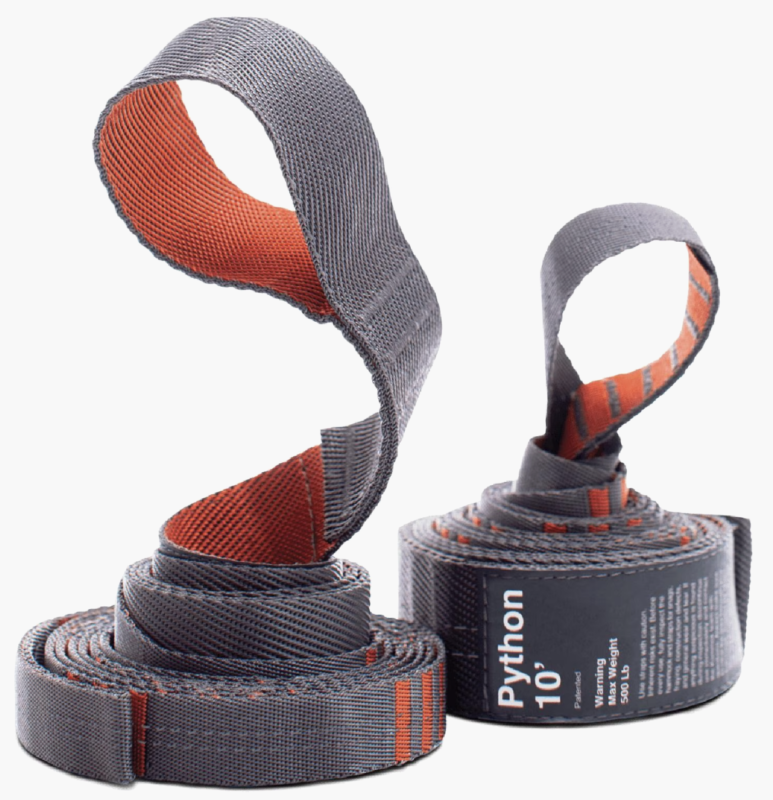
The Python 10 is often ranked as a top overall pick for hammock straps, and it’s easy to see why. At 8.2 oz with 500 lb capacity and 10 ft of length per strap, it hits the sweet spot between lightweight and full-featured.
Kammok’s patented Nanoweave construction weaves the daisy chain connections instead of bar-tacking them, which cuts bulk and weight while maintaining strength. Each strap has 20 loops (40 combined), the most adjustment points in a standard-length strap on this list. The variable-width design goes from 1.5″ at the tree end to .75″ on the daisy chain for a good balance of tree protection and packability. Reflective tracers add nighttime visibility.
The Python 10 works with any hammock that uses carabiners. Kammok backs it with a lifetime warranty.
Want to go ultralight? The Kammok Python 10 UL (~$55) uses Spiraline fiber (15x stronger than steel) to drop the weight to just 3 oz while keeping the same 10 ft length and 20 loops per strap. Capacity drops to 300 lbs. At 3 oz, it’s the lightest hammock strap option from a major brand.
Need more length? Kammok Python Extenders (~$25) add nearly 10 ft of length with 2″ wide webbing for maximum tree protection. They work with any hammock straps, not just Kammok’s.
- Length: 10 ft per strap (20 ft combined)
- Loops: 20 per strap (40 combined)
- Weight capacity: 500 lbs per strap
- Weight: 8.2 oz
- Width: 1.5″ tapering to .75″
- Includes: 2 straps, stuff sack
- Best for: Camping, all-around use, best balance of weight and features
Kammok Python 15 Hammock Straps
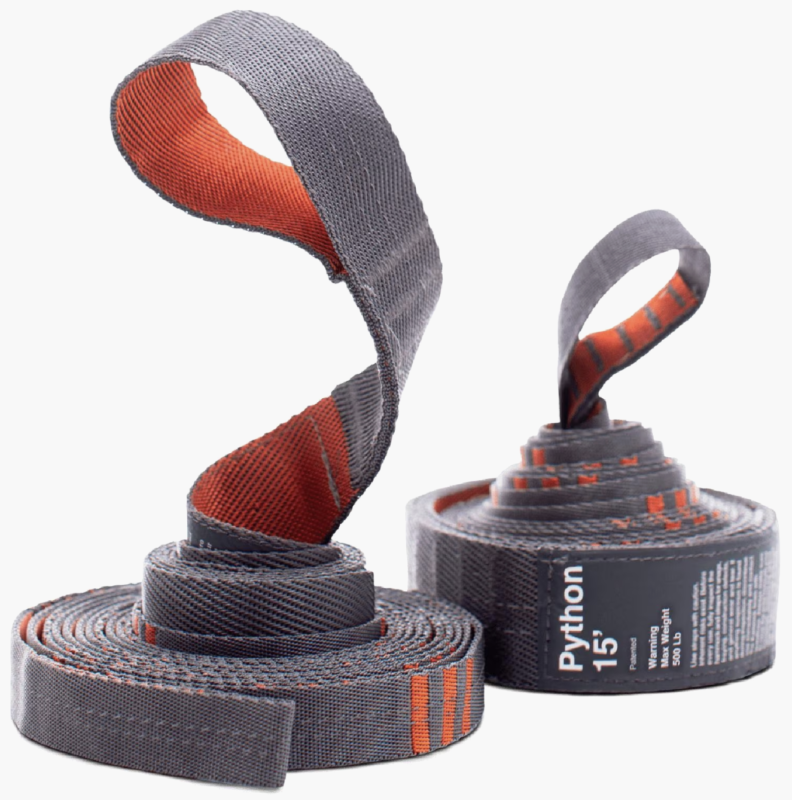
The longest straps from a major brand. Each strap is 15 ft (30 ft combined), which means you can hang between trees that are absurdly far apart, or wrap around massive trunks without running out of strap.
Each Python 15 strap has 33 loops (66 combined), the most on any strap I’ve seen. Same Nanoweave construction and variable-width design as the Python 10. The 500 lb per strap capacity means these will handle anything.
At 11.8 oz they’re heavier than the Python 10, but that’s the cost of 10 extra feet of strap. If you camp in old-growth forests, desert areas with sparse trees, or just hate the feeling of barely reaching, these solve the problem.
Like the Python 10, Kammok Python Extenders are available if you somehow need even more length. Same lifetime warranty.
- Length: 15 ft per strap (30 ft combined)
- Loops: 33 per strap (66 combined)
- Weight capacity: 500 lbs per strap
- Weight: 11.8 oz
- Width: 1.5″ tapering to .75″
- Includes: 2 straps, stuff sack
- Best for: Wide tree spacing, thick trunks, maximum adjustability, car camping
ENO vs. Kammok: what’s the difference?
Both are top-tier hammock brands, and you won’t go wrong with either. But the product lines are designed differently.
ENO offers the widest range of strap types. The Atlas is the standard daisy chain. The Helios is a whoopie-sling-style ultralight system. The Apollo is a heavy-duty, infinite-adjustment backyard strap. Each fills a distinct niche, but they’re not interchangeable. You choose based on your use case.
Kammok keeps it simpler: the Python 10 and Python 15 use the same Nanoweave daisy chain construction in two lengths, with an ultralight version (Python 10 UL) and extenders available. One system, scaled up or down. If you don’t want to think about which strap type to get, Kammok’s lineup is more straightforward.
On specs, the Kammok Python 10 edges out the ENO Atlas in length (10 ft vs. 9 ft), loops (40 vs. 30), capacity (500 lbs per strap vs. 400 lbs combined), and weight (8.2 oz vs. 9 oz). The Atlas counters with wider tree-end webbing (1.5″ vs. Kammok’s variable 1.5″ to .75″) and the reflective center stitching.
For ultralight, ENO’s Helios (4.3 oz, infinite Microtune adjustment) and Kammok’s Python 10 UL (3 oz, 20 daisy chain loops) are both excellent. The Kammok is lighter; the ENO is more adjustable.
How to hang a hammock with tree straps
Setting up is straightforward once you’ve done it a few times.
Step 1: Find two sturdy trees about 10 to 15 feet apart. Look for healthy trees with trunks at least 6 inches in diameter. Check above for dead branches. Avoid trees in wet areas that might uproot.
Step 2: Wrap one strap around a tree at about head height (5 to 6 feet). Feed the end with the loops through the small loop on the opposite end. Pull tight so it grips the bark.
Step 3: Repeat on the other tree.
Step 4: Clip your hammock’s carabiners into one of the loops on each strap. Start in the middle and adjust from there.
Step 5: Sit in the hammock and test it. You want about a 30-degree angle between the strap and the ground, and the bottom of the hammock should sit about 18 inches off the ground.
Step 6: Adjust. Move the carabiner to a higher or lower loop to change the height and tension. The classic mistake is hanging too tight. A gentle banana curve is more comfortable than a taut, flat hang.
How far apart should the trees be?
It depends on the combined length of your hammock and straps. Using an ENO DoubleNest hammock (about 6’2″) with ENO Atlas straps (9 ft per side), you have about 24 feet of total length. But the straps have to loop around both trunks, so look for trees 12 to 18 feet apart.
Trees as close as 7 feet can work for sitting upright, but lying down comfortably usually requires at least 10 to 12 feet of spacing.
If you’re frequently coming up short, grab a pair of longer straps (Atlas XL at 13’6″, Kammok Python 15 at 15 ft) or add extenders.
Do hammock straps damage trees?
Done right, no. Wide, flat webbing straps distribute weight across the bark and don’t dig in. The key rules:
- Use straps at least 1″ wide (1.5″ or wider is better).
- Never use rope, paracord, wire, or zip ties on trees.
- Don’t leave straps on trees for extended periods. Take them down when you’re done.
- Only hang from one tree per hammock end. Don’t stack multiple hammocks on the same tree.
- Check your park’s specific regulations. Some require 1.5″ or 2″ wide straps.
How to hang a hammock without trees
No trees? No problem. Check out our guide to the best portable hammock stands, how to hang a hammock indoors, and folding hammocks with stands.